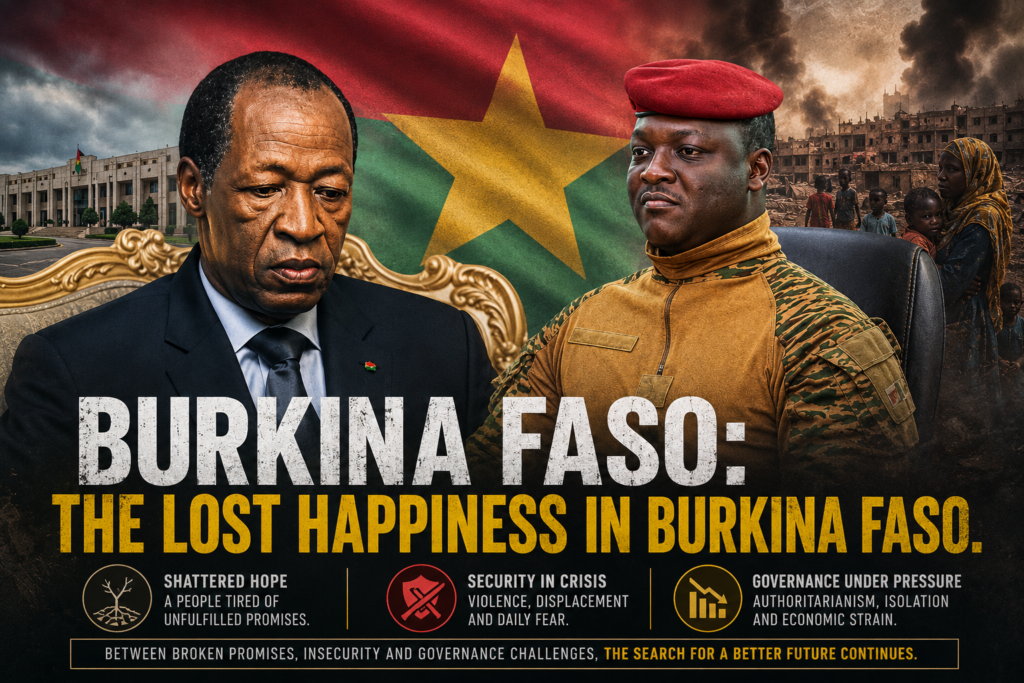
The Burkina Faso of yesterday was known more for its stability than for its crises. While that period was not without criticism, it was nonetheless a time when citizens could move freely, farm their lands, and conduct trade without constant fear. The name Blaise Compaoré, who led the country for 27 years, became synonymous with a contested regime—one accused of centralizing power, stifling political opposition, and restricting democratic transitions.
Today, Burkinabè citizens look back with a mix of nostalgia and disillusionment. The stability of the Compaoré era, flawed as it was, now appears starkly different from the reality under Captain Ibrahim Traoré. The question now dominating public discourse is simple yet profound: what value does political debate hold when the most basic right to safety is no longer guaranteed?
Under Compaoré, Burkina Faso did not face the level of armed violence that now plagues the Sahel. Villages were not cut off from one another, farmers could work without fear, and travelers could journey across regions without dreading ambushes or kidnappings. Terrorism had not yet escalated into the full-blown security crisis that now defines daily life for millions.
This does not absolve the criticisms leveled against Compaoré’s rule. His government was widely condemned for suppressing dissent and manipulating institutions to prolong its hold on power. Yet the security of ordinary citizens was, for the most part, maintained. Today, that fundamental expectation has collapsed. Roads once bustling with commerce now carry the risk of attack. Villages once thriving now stand abandoned. Markets once vibrant with activity now struggle to function.
Promises unmet: the gap between rhetoric and reality
When Ibrahim Traoré assumed power following a military coup, expectations were high. The new leadership vowed to reclaim lost territory, restore national sovereignty, and dismantle armed groups threatening the nation. Yet nearly half a decade later, these promises remain largely unfulfilled in the eyes of many.
Official statements continue to report military victories and territorial gains. But for countless families, these declarations do not translate into real-life security. In regions across the country, attacks persist, supply routes remain perilous, and entire communities live in isolation. The disconnect between government announcements and ground-level realities fuels widespread frustration.
The exodus of a nation: when safety lies beyond borders
The most glaring indictment of the current situation is not the persistence of violence alone—it is the mass displacement of citizens who no longer trust their own country to protect them. Every week, thousands abandon homes, farms, and businesses to seek refuge elsewhere. Some flee to safer areas within Burkina Faso. Others cross into neighboring nations, trading familiar lives for the uncertainty of exile.
No one chooses displacement willingly. When families uproot themselves, it is not a sign of political conviction or economic opportunity—it is a desperate response to a government’s failure to fulfill its most basic duty: ensuring the safety of its people.
The sovereignty paradox: ideals vs. implementation
Ibrahim Traoré’s leadership has championed themes of national sovereignty, defiance against former allies, and patriotic mobilization. These messages resonate with a segment of the population weary of external influence and eager for self-determination. Yet sovereignty is not merely a slogan—it is measured by a state’s ability to exercise control over its territory and protect those who call it home.
The current government’s performance in this regard remains deeply contested. While some former critics of Compaoré have softened their stance, others remain silent, their voices muffled by the weight of unmet expectations. The inconsistency in how different leaders are judged—harsher scrutiny for some, leniency for others—only deepens public skepticism.
Beyond slogans: what defines a nation’s well-being
A nation’s prosperity cannot be measured by the strength of its slogans or the popularity of its leader. It is defined by the tranquility of its villages, the safety of its roads, the functioning of its schools, and the vibrancy of its markets. It is measured by the confidence families place in their future, by their ability to live, work, and dream without fear.
Until Burkinabè citizens no longer feel compelled to abandon their homes in search of security, the verdict on Ibrahim Traoré’s leadership will remain unresolved. History does not record speeches or promises—it records actions. And the actions required are clear: restore safety, reclaim trust, and ensure that every citizen can live with dignity, in peace, and without fear.