
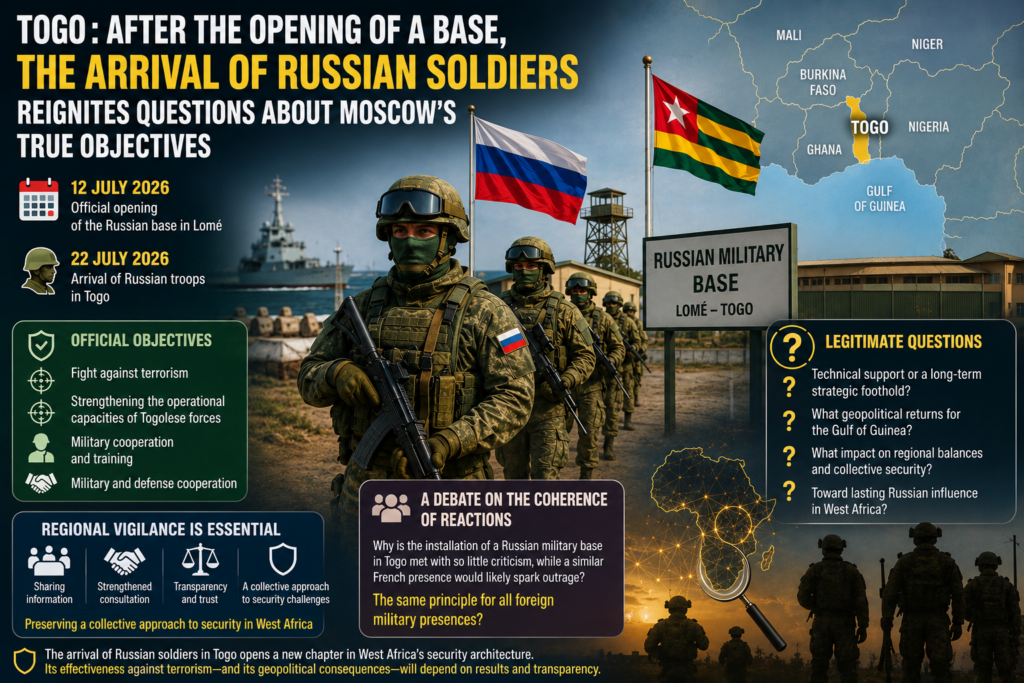
The deployment of Russian troops to Togo, confirmed on July 22, 2026—shortly after the inauguration of a Russian military base on July 12—marks a significant milestone in the deepening defense collaboration between Lomé and Moscow. According to official statements, these soldiers have been dispatched to bolster anti-terrorism efforts and enhance the operational readiness of Togolese armed forces.
Russia’s expanding footprint in Africa
The arrival of Russian military personnel in Togo reflects a broader trend: Moscow’s steady expansion of its influence across the African continent. Over recent years, the Kremlin has secured defense agreements, provided military training, supplied weaponry, and in select cases, stationed troops on African soil. Togo’s decision to host Russian forces aligns with this wider strategy of strengthening ties with governments seeking alternative security partnerships.
Strategic implications and unanswered questions
While the Togolese government asserts its sovereign right to choose its defense partners, analysts point to potential regional repercussions. The installation of a foreign military presence—particularly in a volatile subregion facing persistent jihadist threats—could reshape strategic balances in West Africa. The key questions now revolve around the true objectives behind this cooperation: Is it purely a technical and operational support mission to counter armed groups operating near the northern border, or does it signal a long-term Russian ambition to extend its influence into the Gulf of Guinea?
The implications of such an arrangement go beyond immediate military assistance. A foreign military presence can facilitate intelligence-sharing, specialized training, logistical coordination, industrial cooperation, and defense diplomacy—factors that may have far-reaching consequences for regional stability.
Divergent reactions raise concerns over double standards
A striking aspect of the public discourse is the uneven response to foreign military presence depending on the country of origin. Observers note that had a French base been established in Togo under similar circumstances, the reaction—especially on social media—would likely have been far more critical. This discrepancy has prompted some analysts to question whether judgments are based on principle or on geopolitical alignment.
Several governments in the Alliance des États du Sahel (AES) have repeatedly criticized the presence of French forces in West Africa, portraying it as a form of interference or destabilization. Yet, the reception of Russian military personnel in Togo has, to date, drawn relatively little backlash from the same circles. This inconsistency fuels debates about the consistency of sovereignty concerns and the criteria used to evaluate foreign military engagements.
Regional vigilance and the importance of transparency
For neighboring states, the evolving security landscape demands heightened attention. While recognizing Togo’s right to forge independent defense partnerships, regional actors must closely monitor the development of this cooperation to assess its impact on collective security, regional mechanisms, and diplomatic alignments in West Africa.
In an environment where terrorist threats transcend borders and external powers intensify their competition for influence, transparency becomes crucial to fostering trust. Strengthening information-sharing and joint consultation frameworks could help mitigate misunderstandings and preserve a unified approach to regional security challenges.
Looking ahead: assessing outcomes and consequences
The establishment of a Russian military presence in Togo opens a new chapter in West Africa’s security architecture. Its effectiveness in combating terrorism and its broader geopolitical ramifications will only become clear through tangible results on the ground and the evolving dynamics between Lomé, Moscow, and other regional governments.


More Stories
Niger : ce que les remaniements militaires disent des tensions au sommet du pouvoir
Togo’s enduring power question: Faure Gnassingbé and the shifting architecture of rule
Educational decay overshadows symbolic cartography in Togo