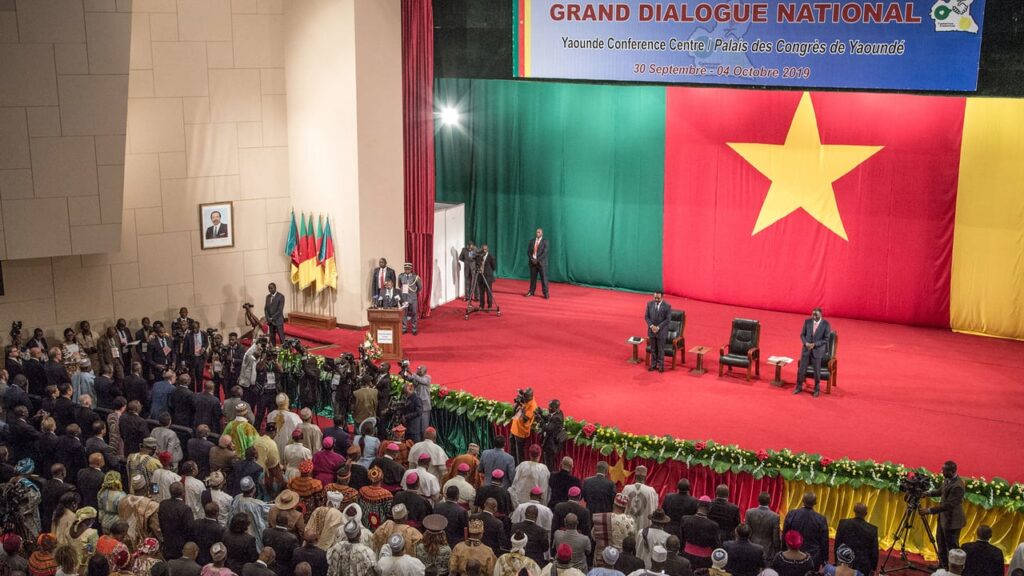

The notion of returning Cameroon to a federal structure has resurfaced as a potential solution to the deepening crisis in the country’s anglophone regions. This debate, reignited by recent political developments, questions whether decentralization could restore stability or merely intensify existing divisions.
Historical Roots Of Cameroon’s Political Structure
The idea of federalism in Cameroon traces back to the nation’s early post-independence years. Between 1961 and 1972, the country operated under a federal system that united two distinct regions—French-speaking and English-speaking—each with its own administrative autonomy. The system was eventually dismantled in favor of a centralized unitary state under President Ahmadou Ahidjo, a move later consolidated by his successor, Paul Biya.
Critics argue that the elimination of federalism stripped anglophone regions of their political voice, fueling grievances that persist today. Supporters of a return to federalism contend that it could address historical injustices and provide a framework for equitable resource distribution.
Current Challenges In The Anglophone Regions
The anglophone crisis, which erupted in 2016, has exposed the limitations of Cameroon’s current governance model. Protests by lawyers, teachers, and civil society groups over perceived marginalization quickly escalated into armed conflict, with separatist factions demanding full independence. The government’s response—a mix of military crackdowns and dialogue initiatives—has yet to yield lasting peace.
Against this backdrop, federalism is often presented as a compromise: granting greater autonomy to anglophone regions while maintaining national unity. However, skepticism remains about whether such a system could be implemented without reigniting broader ethnic or regional tensions.
Key Obstacles To Federalism
- Political Resistance: The central government has historically opposed federalism, viewing it as a threat to national cohesion. Recent attempts at decentralization have fallen short of devolving meaningful power.
- Economic Disparities: Anglophone regions, rich in natural resources, argue that a federal system would ensure fairer revenue sharing. However, critics warn that unequal development could persist without robust economic reforms.
- Security Concerns: Separatist groups reject federalism as insufficient, insisting on outright independence. Their refusal to engage in dialogue complicates any potential transition.
Could Federalism Work Today?
Proponents of federalism point to successful examples in other African nations, such as Nigeria and Ethiopia, where decentralized governance has helped manage ethnic diversity. In Cameroon, advocates argue that a revised federal structure—one that balances regional autonomy with strong national institutions—could mitigate conflicts.
Yet, the path forward is fraught with challenges. The government’s 2019 National Dialogue, led by Prime Minister Joseph Dion Ngute, explored federalism as a possible solution but failed to secure buy-in from key separatist leaders. Without inclusive negotiations, any federal proposal risks being dismissed as superficial.
Public Sentiment And Regional Dynamics
Opinion within Cameroon remains divided. While some anglophone communities express support for federalism, others remain skeptical, fearing it could entrench divisions rather than resolve them. Meanwhile, the francophone majority largely opposes federalism, viewing it as a step toward balkanization.
The debate also intersects with broader questions about Cameroon’s identity. As the country grapples with separatist violence and economic stagnation, the federalism question is no longer just theoretical—it is a litmus test for the nation’s future.


More Stories
Can Senegal’s local elections be Bassirou Diomaye Faye’s make-or-break moment?
Senegal’s parliament: What power does Ousmane Sonko hold to derail the 2026 budget?
Senegal’s December 2 dilemma: can Diomaye Faye’s gamble reshape the nation’s future?